
Changes to Council Tax Rules for Empty and Second Homes
Council Tax on empty and second homes can now cost owners far more than the standard bill. In England, some councils can double the charge on a second home. Homes left empty for years can face even larger premiums. Wales allows higher local premiums, while Scotland changed its system in April 2026. Northern Ireland uses domestic rates instead. This guide explains what may raise your bill and when an exception may help.
Is Your Property Empty or a Second Home?
The label matters.
An empty home is normally unoccupied and mostly unfurnished. A second home is usually furnished but is not anyone’s main home.
For Council Tax on empty and second homes, councils look at how the property is really used. Owning two homes does not always determine the category.
How Much More Can a Second Home Cost in England?
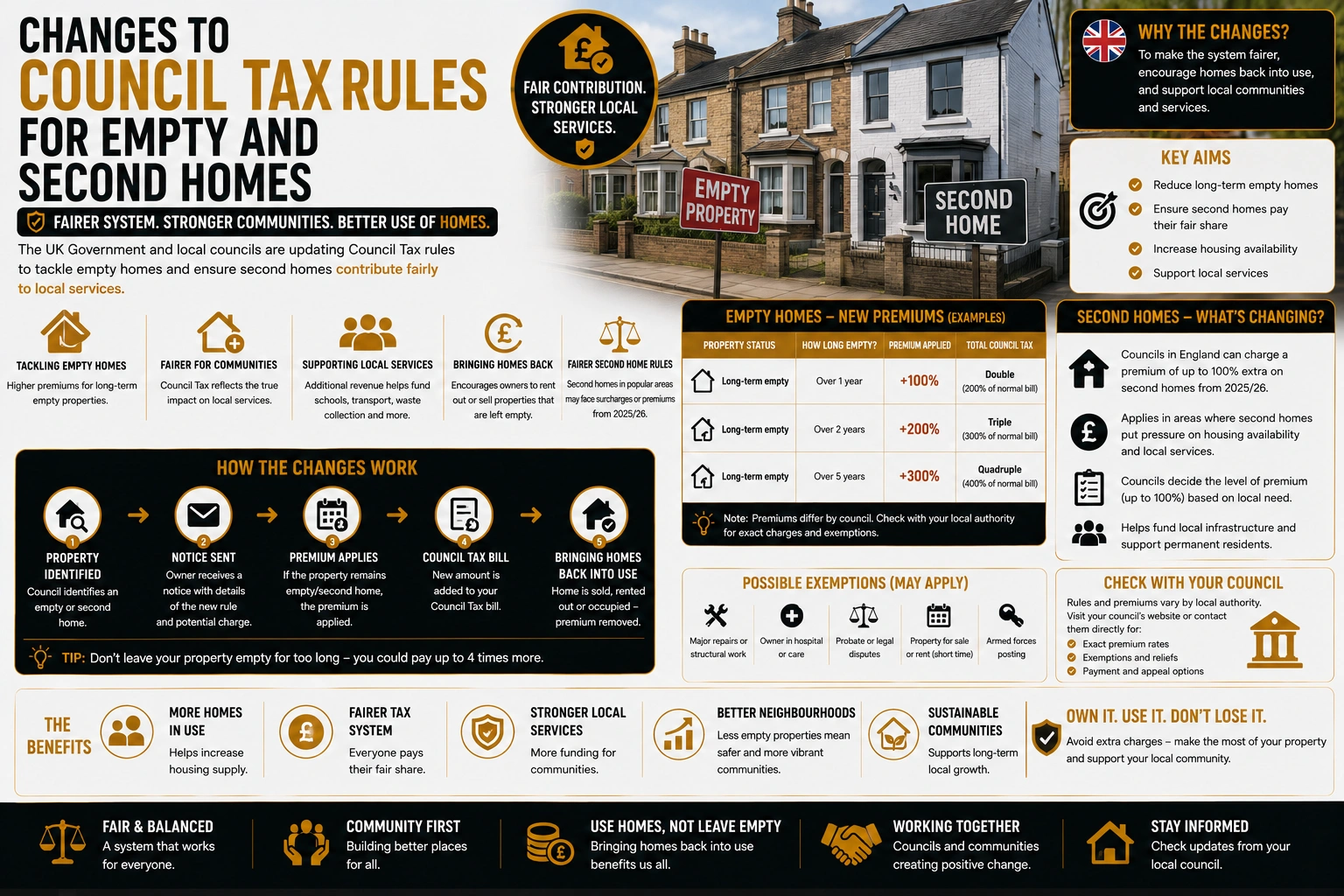
Since April 2025, English councils can add a second home Council Tax premium of up to 100%. A normal £2,000 bill could rise to £4,000 where the full premium applies.
Each council decides whether to use the charge and what rate to set. Check the council where the property sits before working out your yearly cost.
What Happens When a Home Stays Empty?
Empty property Council Tax can rise as the empty period gets longer.
In England, a home can become long-term empty after one continuous year. Councils can then add a Council Tax premium.
The maximum extra premium can be:
- 100% after 1 year
- 200% after 5 years
- 300% after 10 years
A 300% premium is added to the normal bill. So the total can reach four times the usual amount. This is why long-term empty homes can become very costly.
Can You Reset the Empty-Home Clock?
A short stay will not normally reset it.
In England, the home must be occupied or substantially furnished for at least six continuous weeks. A few nights in the property will not usually be enough.
This matters when buying an empty house. Check how long it has been empty before you buy.
When Can the Extra Charge Be Removed?
Council Tax exemptions and premium exceptions are not the same.
An exemption can remove the normal charge in certain cases. A premium exception may only remove the extra amount.
In England, exceptions can apply in some cases while a home is being sold or let. Other rules cover some probate homes, job-related homes, annexes, and homes with legal limits on use.
Some exceptions last only for a set time. Ask the council what proof it needs.
What Changed in Scotland in 2026?
Scotland changed the system on 1 April 2026.
The national default premium for second homes and long-empty homes is now 100%. Councils can set a higher or lower amount, charge no premium, or use a discount in some cases.
The old national cap has gone. So Council Tax on empty and second homes can vary much more across Scotland.
How Do the Rules Work in Wales?
Welsh councils can add premiums to second homes and long-term empty properties. The maximum can reach 300% of the standard charge.
Each council sets its own level. This means the second home premium may be very different from one part of Wales to another.
What About Northern Ireland?
Northern Ireland uses domestic rates, not Council Tax.
Empty homes normally still have a rates bill, and the owner is usually responsible. The basic charge is generally the same whether the home is empty or occupied.
Some empty homes can get full relief. An automatic exclusion can apply when the capital value is below £20,000.
What Should You Check Before Your Next Bill?
Don’t wait for a large bill to check the details.
Look at:
- How the council has classed the home
- The date it became empty
- Your local premium rate
- Whether an exception applies
- Whether the council has the right dates
For Council Tax on empty and second homes, the Council Tax Rules 2026 make dates and local policy especially important. Keep useful proof, such as sale listings, rental adverts, probate papers, or occupation records.
Final Thoughts: What Do These Changes Mean for Owners?
Council Tax on empty and second homes now depends heavily on location and property history. A second home can cost twice the normal bill in some English areas. A long-empty home can cost even more. Scotland now gives councils wider freedom, while Wales can use very high premiums. Northern Ireland follows a separate rates system. Check the local rules before you buy, leave, sell, or keep another home so the next bill does not come as a shock.
FAQs
1. Do you pay extra Council Tax on a second home?
You may pay more. English councils can add up to a 100% premium. Your council sets the rate.
2. How much Council Tax do you pay on an empty home?
It depends on how long it stays empty. In England, the bill can rise over time. After 10 years, it can reach four times the normal charge.
3. When does a home become long-term empty?
In England, this can happen after one year. The home must be unoccupied and substantially unfurnished. The council then decides the premium.
4. Can Council Tax double on a second home?
Yes, it can in England. A 100% premium can be added. That doubles the normal bill.
5. Can Council Tax be four times higher on an empty home?
Yes, after 10 years in England. The maximum extra premium is 300%. Councils can choose less.
6. Does selling an empty home stop the premium?
Not always. A temporary exception may apply during a genuine sale. The property must meet the rules.
7. Do I pay an empty-home premium during repairs?
It depends on the case. Some homes may get different treatment. Ask the council before relying on it.
8. Can a second home avoid the Council Tax premium?
Some homes can qualify for an exception. The reason and time limit can vary. Evidence may be needed.
9. Are second-home Council Tax rules the same across the UK?
No. England, Wales, and Scotland use different systems. Northern Ireland uses domestic rates.
10. Do empty homes pay rates in Northern Ireland?
Yes, they normally do. Some properties can get full relief. Land & Property Services handles the rules.