

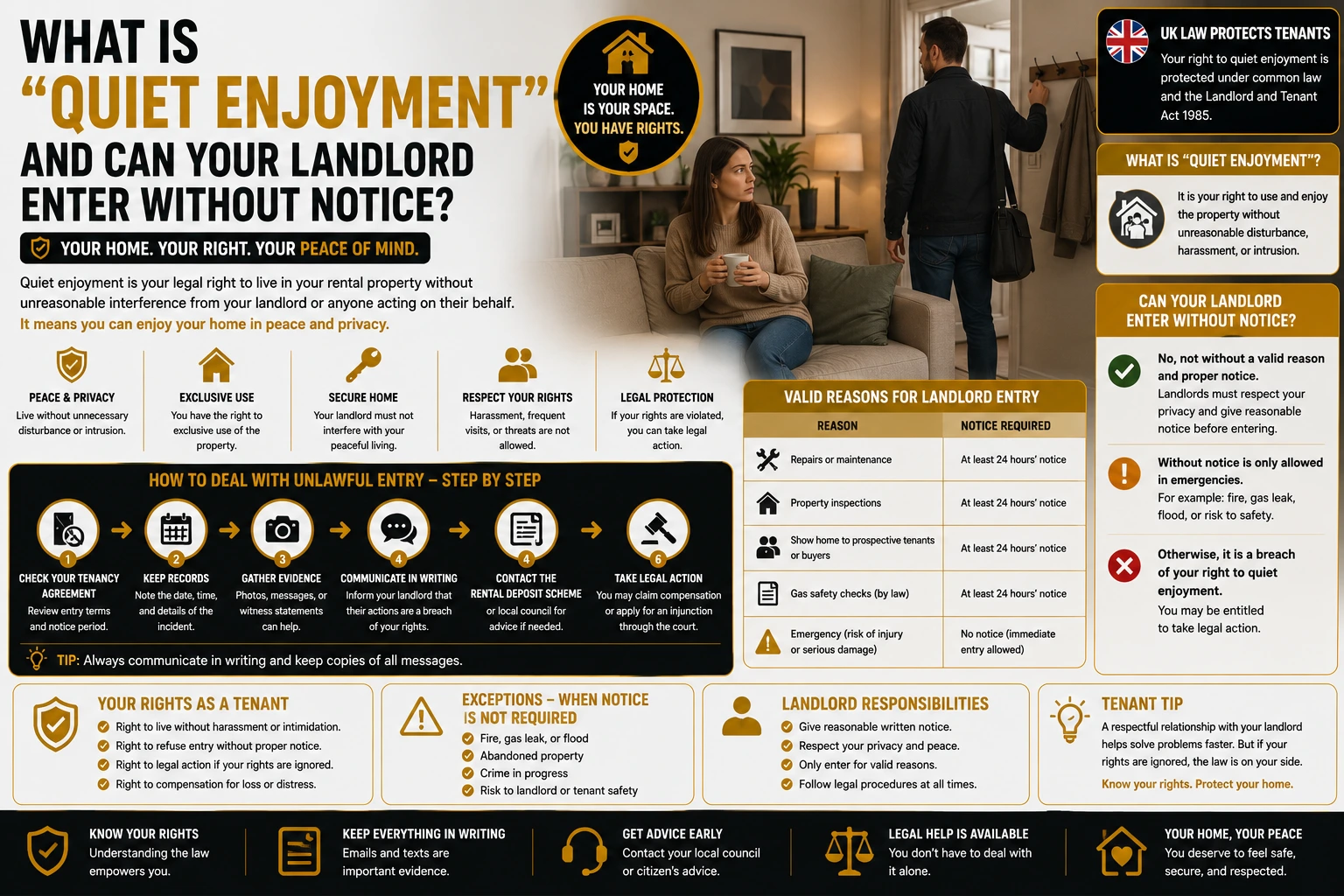
What Is “Quiet Enjoyment” and Can Your Landlord Enter Without Notice?
Quiet enjoyment means that you can enjoy your rented room since the landlord doesn’t interfere unreasonably. This secures your tenant’s privacy rights while giving essential checks and repairs too. In England, landlords usually require advance notice before having access for checks. However, notice doesn’t give them the right to walk into the house at any time without any prior notice. Genuine emergencies are another thing, and sometimes, emergency landlord access can be given.
Your Home, Your Space
The concept of quiet enjoyment is not just about noise. It means that you can live peacefully at your home, without any sudden landlord disturbances. If the landlord visits the place repeatedly or uses the spare key, it may cross the line.
A landlord can still arrange all the repairs, inspections, and routine work. But your quiet enjoyment rights ask them to plan those visits at a reasonable time.
When Can They Visit?
Landlords may need access for repairs, property checks, or safety work. Their landlord inspection rights allow reasonable visits, but these rights are not unlimited.
The 24-Hour Rule
In the UK, landlords need to give 24 hours’ written notice to enter the home for repairs or inspections. This 24-hour notice landlord rule lets the tenants prepare and respond accordingly.
A proper landlord access notice should clearly mention the date, time, and the reason for the visit. If the time doesn’t look appropriate to you, you can suggest another time.
Notice, Permission, or Emergency?
|
Situation |
Notice Needed? |
Can They Enter Immediately? |
|
Routine inspection |
Normally yes |
Normally no |
|
Non-urgent repair |
Normally yes |
Normally no |
|
Safety check |
Normally yes |
Access should be arranged |
|
Property viewing |
Usually arranged in advance |
Not automatically |
|
Serious water leak |
May not be possible |
Possibly, if urgently necessary |
|
Fire or gas emergency |
Immediate access may be needed |
Yes, where necessary |
This difference is important, as your tenant privacy rights can’t block the landlord’s reasonable access. They simply help you avoid the unnecessary interference.
Notice Is Not Permission
The most common misunderstanding is the landlord entry without permission. A landlord should not normally send notice and then assume they can unlock the door whenever they arrive.
What About a Spare Key?
A spare key does not give the landlord unlimited access. Routine visits should still be arranged with the tenant first.
If essential access is repeatedly refused, the landlord should follow the proper legal process. Landlord inspection rights don’t mean that they can enter forcefully for an ordinary inspection.
When No Notice Is Needed
Emergencies are different because waiting could place people or property at serious risk. Emergency landlord access may therefore be reasonable when immediate action is genuinely necessary.
Examples include:
- A burst pipe or major water leak
- Fire or clear signs of fire
- A suspected gas leak
- Dangerous electrical faults
- Serious damage affecting nearby homes
- An immediate risk to someone inside
Emergency access should only deal with the urgent issue. It should not be used as an excuse for unrelated inspections.
If It Keeps Happening
Repeated landlord entry without permission may become more than a minor tenancy dispute. Unnecessary multiple visits can disturb your privacy. It can even lead to harassment concerns in some cases.
Put It in Writing
Tell the landlord or agent that future visits must be arranged properly. Keep records in the form of messages, dates, and photographs.
If unwanted access continues, seek advice from your local council, Shelter, Citizens Advice, or a housing adviser.
Check Your Location
Housing rules vary across different parts of the UK, like England, Scotland, Wales, and Northern Ireland. The 24-hour notice landlord rule discussed here mainly relates to repair and condition inspections in England.
Other parts of the UK have different access rules. Always check which landlord access notice requirements apply to your tenancy and location.
Conclusion
Quiet enjoyment gives real control to tenants over their rented home. Landlords can still arrange repairs, inspections, and safety work when needed. Proper notice is important, but it does not normally create an automatic right to enter. Genuine emergencies are the main exception where immediate emergency landlord access may be justified. Respect for tenant privacy rights helps keep access fair for both landlords and tenants.
FAQs
1. What does quiet enjoyment mean for tenants in the UK?
Your quiet enjoyment rights protect you from unreasonable landlord interference. They cover privacy and peaceful use of your rented home. The right normally continues throughout the tenancy.
2. Can a landlord enter your home after giving 24 hours’ notice?
The 24-hour notice landlord rule usually requires advance notice for certain visits. Notice does not automatically give the landlord permission to enter. Access should normally be arranged with the tenant.
3. Can a landlord enter a rented property in the absence of the tenant?
Routine landlord entry without permission should not normally happen because you are away. You can allow the landlord to use a key. Otherwise, you should arrange access.
4. Can a tenant refuse a landlord’s inspection in England?
A landlord has certain inspection rights for necessary checks. You can normally ask for another reasonable time. Repeatedly refusing essential access may cause legal problems.
5. Can a landlord keep a spare key to a rented property?
Yes, a landlord may keep a spare key. Your tenant privacy rights still limit when it should be used. Having a key does not give unlimited access.
6. When can a landlord enter a property without notice?
Emergency landlord access may be justified when waiting could cause serious harm or damage. Examples include fire, major leaks, or a suspected gas leak. Routine repairs are not usually emergencies.
7. Does a landlord have to give written notice before entering?
A landlord access notice should normally be given in writing for relevant inspections in England. At least 24 hours’ notice is generally required. They should visit at an appropriate time that works for both parties.
8. Can a landlord enter a rented property for viewings?
Viewings should normally be arranged with the tenant in advance. Quiet enjoyment still protects tenants from unreasonable or repeated visits. A viewing clause does not give the landlord unlimited access.
9. What can a tenant do if a landlord keeps entering without notice?
Repeated unwanted visits may affect your tenant’s privacy rights. Keep records and ask the landlord to arrange future access properly. Seek housing advice if the problem continues.
10. Are landlord access rules the same across the UK?
No, landlord inspection rights differ across the UK. The 24-hour rule discussed here mainly reflects the position in England. Tenants elsewhere should check the rules for their nation.