

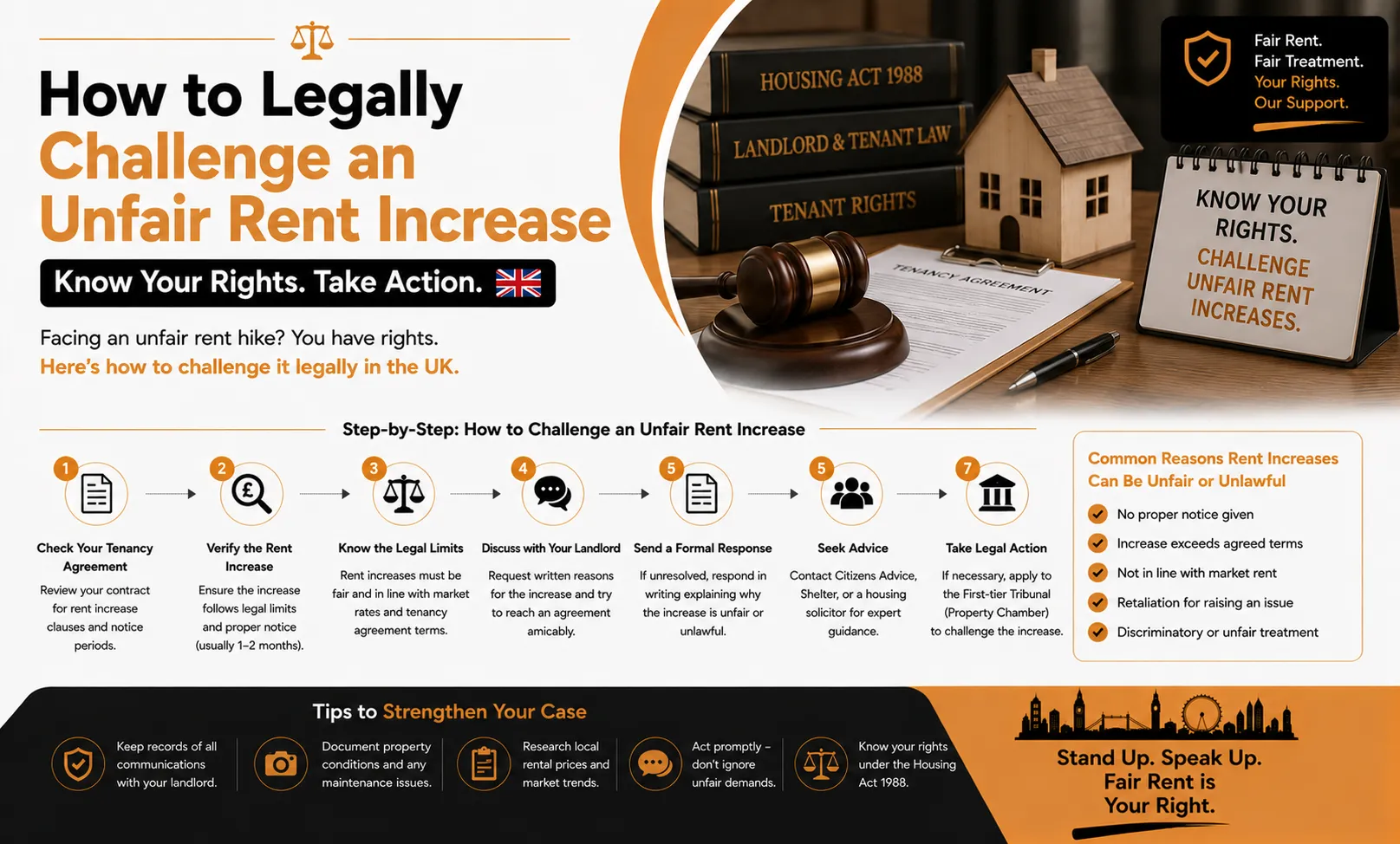
How to Legally Challenge an Unfair Rent Increase
If you want to legally challenge an unfair rent increase, the first step is to know your rights. A rent rise can feel worrying, especially if it is sudden or much higher than nearby homes. You should not agree straight away if the new rent feels wrong. First, check the notice, compare local rents and understand the legal route. This guide explains how tenants in England can check a rent rise, speak to the landlord and apply to a tribunal if needed.
What Counts as an Unfair Rent Increase?
An unfair rent increase is usually a rise that is higher than the normal market rent for similar homes nearby. For example, if other two-bedroom flats in your area are cheaper, your landlord may need to justify the higher amount.
Condition also matters. If your home has damp, poor heating, old fittings or repair issues, this can help show that the new rent is too high compared with similar homes.
Check the Rent Increase Notice
Before you do anything, check the rent increase notice carefully. It should show the new rent, the start date, your details and the correct legal form.
For many assured periodic tenants in England, landlords now need to give at least 2 months’ notice using Form 4A. GOV.UK also says tenants can ask the First-tier Tribunal to decide the open market rent if they think the proposed increase is too high.
Know Your Tenant Rights
Understanding tenants’ rent-increase rights can help you avoid rushed decisions. In many cases, you do not have to accept the new rent just because your landlord asks for it.
From 1 May 2026, many private tenants in England can challenge a proposed increase before the new rent starts. Shelter says tenants must apply before the date shown on the section 13 notice.
Speak to Your Landlord First
Before going to a tribunal, it is often worth speaking to your landlord. Explain clearly why the rent feels too high and show examples of cheaper local homes.
This can help you challenge rent rise plans without a formal case. If your landlord agrees to a lower amount, make sure you get the new rent and start date in writing.
Gather Strong Evidence
Good evidence can make your case much stronger. You need to show why the proposed rent is above the market level.
Useful evidence includes:
- similar rental listings nearby
- photos of repair problems
- your tenancy agreement
- the section 13 notice
- emails with your landlord
- details of local property condition
- letting agent rent estimates
Citizens Advice says tenants should collect evidence such as nearby rents, repairs the landlord is responsible for and improvements the tenant has paid for.
Quick Checklist Before You Challenge
|
What to Check |
Why It Matters |
|
Correct form |
Wrong forms can cause problems |
|
Notice period |
You need enough legal notice |
|
Start date |
This affects your deadline |
|
Local rents |
Shows if the rise is too high |
|
Property condition |
Poor condition may support your case |
|
Written proof |
Helps avoid confusion later |
This checklist helps you understand your tenant rent increase rights before taking action. It also helps you avoid missing important details.
Applying to the Rent Tribunal
Many people search for rent tribunal UK, but in England this usually means the First-tier Tribunal Property Chamber. You can apply if you believe the rent increase is above the open-market rent.
GOV.UK says tenants can use form MR1 to apply for an open market rent decision. Shelter says it costs £47 to apply from 1 May 2026.
What the Tribunal Looks At
The tribunal does not decide based only on what you can afford. It mainly looks at what similar homes in the area would rent for.
It may consider size, location, condition, features and local demand. This is why your evidence should be clear, simple and directly linked to your home.
Can Your Landlord Evict You?
Many tenants worry that challenging rent will lead to eviction. Shelter says the Renters’ Rights Act changes mean you cannot be evicted just for challenging a rent increase.
Still, keep paying your current rent while the matter is being checked. If you stop paying without advice, you may create a separate rent arrears problem.
Final Verdict
To legally challenge an unfair rent increase, act early and stay organised. Check the rent increase notice, compare local rents and speak to your landlord first.
If that does not work, the rent tribunal UK route may help you get a fair decision. An unfair rent increase can feel stressful, but clear evidence and timely action can protect you from paying more than the market rent.
FAQs
1. Can I legally challenge an unfair rent increase?
Yes, many private tenants in England can challenge a rent rise. You usually need to act before the new rent starts. Check your notice and tenancy type first.
2. What is a rent increase notice?
A rent increase notice is a formal document from your landlord. It tells you the new rent and the date it should start. If the notice is wrong, you may be able to challenge it.
3. How much notice should my landlord give?
Many private tenants in England should get at least 2 months’ notice. The landlord must also use the correct form in many cases. Always check your own tenancy type.
4. Can rent go up more than once a year?
For many assured periodic tenants in England, rent can usually go up once a year. This rule applies under the newer rent increase process. Get advice if your landlord tries to raise it again too soon.
5. How do I challenge rent rise proposals?
You can first speak to your landlord and share local rent evidence. If you cannot agree, you may apply to the First-tier Tribunal. Make sure you apply before the new rent date.
6. What evidence should I collect?
Collect similar rental listings, photos, and repair details. Keep your tenancy agreement and landlord’s notice too. Clear evidence helps the tribunal understand your case.
7. What does the tribunal check?
The tribunal checks the open market rent. It compares your home with similar homes nearby. It can also look at condition, size and features.
8. Can the tribunal set a higher rent?
For section 13 notices given on or after 1 May 2026, the tribunal should not set rent higher than the landlord asked for. It can set the same or a lower amount. This makes the challenge route less risky for tenants.
9. Can my landlord evict me for challenging rent?
Your landlord cannot evict you only because you challenged a rent rise. They must follow the legal process and have a valid reason. Get advice quickly if you receive any eviction notice.
10. When should I get advice?
Get advice if the notice looks wrong or the rise feels too high. You should also get help if you are worried about eviction or do not understand your tenancy terms. Shelter, Citizens Advice, Home World Management or a housing solicitor can guide you on the next step.