

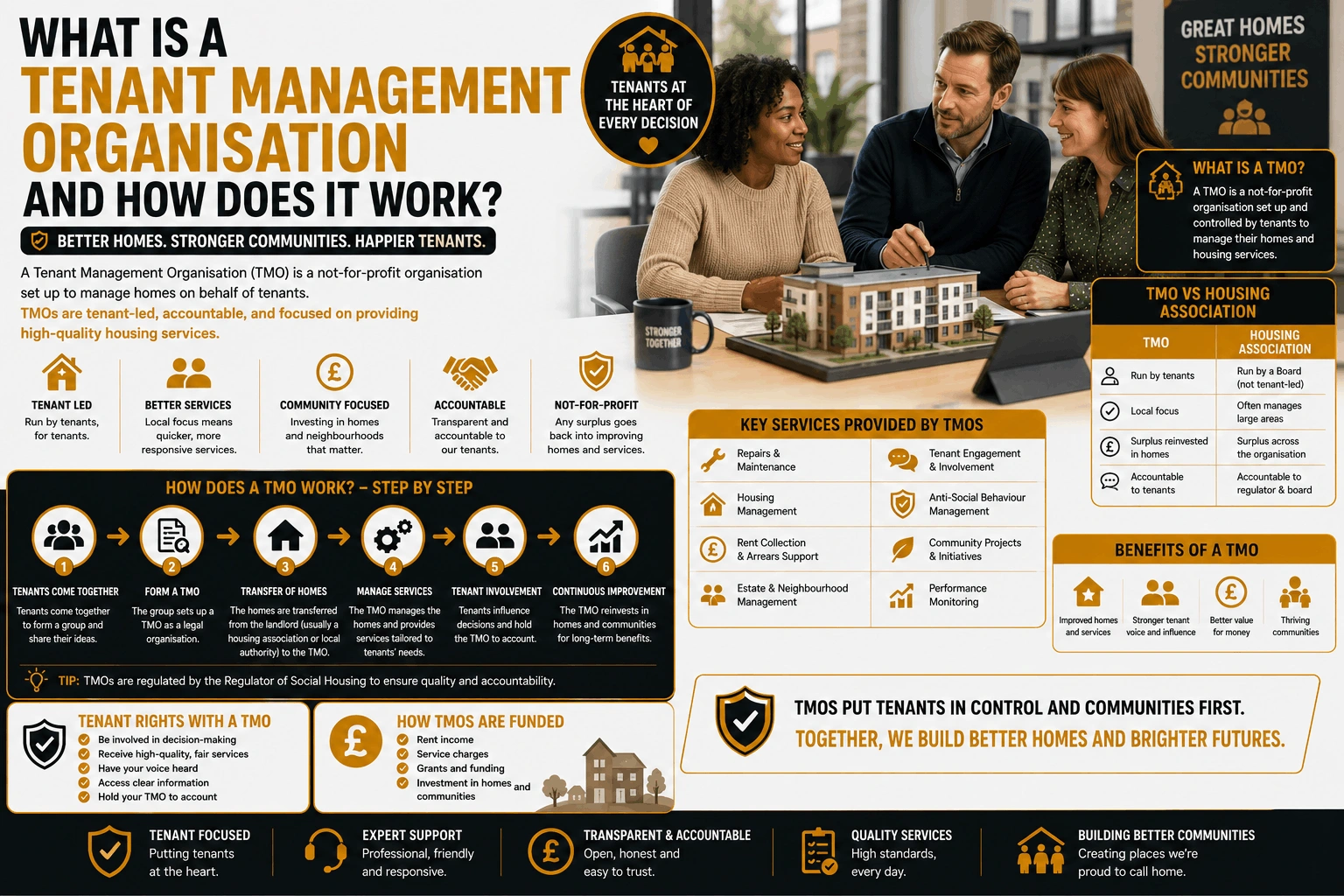
What Is a Tenant Management Organisation and How Does It Work?
A tenant management organisation is a group of council tenants who mutually agree on the housing services in their area and then manage them. In England, these services may comprise repairs, cleaning, caretaking, and some other tenancy services. In this way of tenant-led housing management, the residents can have more control over their estate rules.
The homes are still owned by the council, and they are still the landlords. A formal agreement clearly explains which duties are to be fulfilled by the tenants and which responsibilities are for the council.
What Is a TMO?
A TMO is a legal organisation made by the council tenants and occasionally by the leaseholders. In this tenant management organisation UK model, the locals are responsible for the chosen local housing services. They don’t purchase homes or replace the council as landlords. They just fulfill the responsibilities assigned to them as per the agreement.
Some groups work as tenant management cooperatives, while others can choose some other non-profit model.
What Does a TMO Manage?
The services handled by a TMO depend on the local tenant management agreement. The council and tenant group agree exactly on who will manage each task.
Common TMO Duties
A TMO may manage:
- Day-to-day repairs
- Estate cleaning
- Caretaking services
- Shared gardens and common areas
- Some rent collection duties
- Local tenancy support
- Estate staff
What Stays With the Council?
Not every part of council housing management moves to the tenant group. The council normally keeps major landlord duties, such as setting rents, major structural work, and wider housing policies.
|
Service |
TMO May Manage |
Council May Keep |
|
Repairs |
Routine repairs and maintenance |
Major structural works |
|
Cleaning |
Cleaning of shared areas |
Wider council services |
|
Tenancy support |
Local tenancy issues and support |
Main landlord responsibilities |
|
Finances |
Agreed local budget management |
Rent setting and wider financial duties |
How Is a TMO Created?
If the tenants in England want to get control of their housing services, they can use their tenant management rights. The process applies the Right to Manage regulations and involves many stages as follows:
Forming the Group
First, the locals form an organisation that represents the tenants. They discuss and decide which services and homes they can manage. The organisation formed must also provide ample local support to move the process to the next stages.
Training and Planning
The proposed tenant management organisation must prove that it can manage the services well. The organisation’s members complete their training and propose plans and ideas. They must include the essential components like budgets, staff, repairs, and management.
The organisation also keeps connected with the council. The council decides the budget that will be allocated for those services.
Resident Ballot
Before the roles are formally transferred, the eligible locals are asked to vote. This gives an idea of whether the locals agree with the proposed model or not.
If the required support is met, then the organisation and council can move ahead to complete the agreement.
The Management Agreement
The tenant management agreement is the main part of the arrangement. It states which duties are assigned to the tenants and which go to the council.
What the Agreement Covers
It may comprise:
- Services managed by the TMO
- Annual budgets
- Staff responsibilities
- Performance scores
- Complaint process
- Reporting duties
- Council monitoring
Clarity in tenant-led housing management makes things easier for both parties. They understand their responsibilities better.
Do Tenants Keep Their Rights?
Of course. Forming or becoming a member of a TMO doesn’t mean that you have to give up on your tenant management rights or tenant security. Council tenants remain council tenants, and similarly, leaseholders continue holding their leases.
The Council Is Still the Landlord
The council keeps a hold of its landlord rights and responsibilities. A tenant management organisation is only accountable for the services assigned in the agreement.
The council tracks the performance and may intervene if there are serious problems arising in the organisation.
Why Choose a TMO?
A TMO can make council housing management more local. Residents living on the estate often understand local problems better than a large central housing team.
Possible Benefits
A well-run tenant management co-operative or TMO may offer:
- Quick responses to local problems
- More resident involvement
- Effective communication
- More control over local budget
- Services tailored to the estate’s needs
However, housing services management also places more responsibility. It needs trained and experienced members, better cost controls, transparent records, and more resident involvement.
Conclusion
A tenant management organisation gives council tenants greater control over agreed housing services. The council still owns the homes and remains the main landlord. England’s Right to Manage regulations provide the formal route for eligible tenant groups. Success depends on strong resident support, clear responsibilities, good budgeting, and capable management. When these elements work together, tenant-led housing management can make local housing services more responsive.
FAQs
1. Who can set up a TMO?
Council tenants can gather together and agree on some mutual roles to form a local management group. They can use their tenant management rights to get more control over certain housing services. However, they should follow the legal process to move forward.
2. Does a TMO own council homes?
No, the council remains the owner. The TMO only transfers those services, written in the agreement. Tenants remain the tenants and retain their tenant security.
3. What services can a TMO manage?
A TMO handles agreed services like repairs, cleaning, caretaking and some other tenant services. The exact council housing management responsibilities depend upojn the estates. The local agreement explains the final division.
4. Do residents vote for a TMO?
Yes, resident support is an important part of the formal process. The Right to Manage regulations include steps for showing that residents support the proposal. A ballot normally takes place before management transfers.
5. Can a TMO hire staff?
Yes, a TMO may employ people to provide agreed services. This can support more responsive tenant-led housing management. Staffing costs must remain within the organisation’s budget.
6. Is every TMO a co-operative?
No, TMOs can use different organisational structures. A tenant management co-operative is one common model. Other suitable non-profit structures may also be used.
7. Can a TMO decide council rents?
Normally, the council keeps responsibility for setting rents. Some rent administration may form part of local council housing management arrangements. The agreement should clearly explain who handles each duty.
8. Can the council check TMO performance?
Yes, councils can continue monitoring services after responsibilities transfer. The tenant management agreement normally includes performance and reporting requirements. This helps protect service standards.
9. What happens if a TMO performs poorly?
The council can investigate problems and use the agreed monitoring process. The Right to Manage regulations do not remove council oversight. Serious failures may lead to further intervention.
10. Is the council’s Right to Manage the same as leasehold RTM?
No, they are separate systems with different legal rules. Tenant management rights for council housing relate to taking over agreed housing services. Leasehold Right to Manage follows a different process.