
How to Charge for Property Management Services – UK Pricing Guide
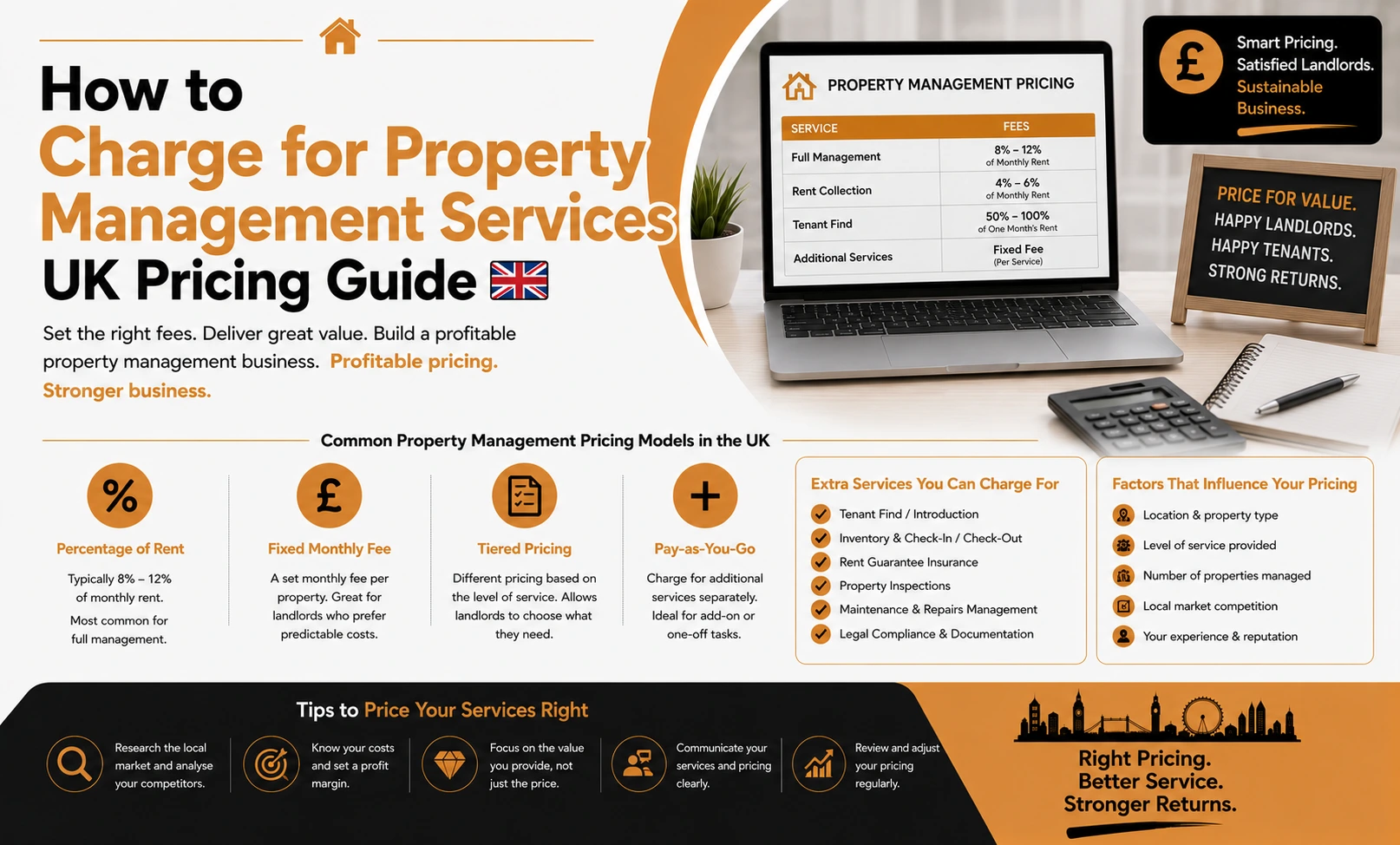
Property management services can be priced in three main ways: a percentage of monthly rent (8-15%), a fixed monthly fee (£50-£150), or an à la carte model where landlords pay only for what they need.
Most residential property management uses the percentage model, while commercial property management favours fixed fees.
This guide walks you through eight steps to set fair, profitable prices, know your local property management cost market, and raise fees without losing landlords.
Know Your Market First
Before setting any prices, research what property management companies in your area charge. Search for “property management near me” and call five local firms pretending to be a landlord. Ask for their fee structure.
London prices are higher than regional ones. A percentage that works in Manchester might be too low for Bristol. Do not price yourself out, but also do not leave money on the table.
Pricing Model 1: Percentage of Monthly Rent
This is the most common model for residential property management. You charge a percentage of the monthly rent, typically between 8% and 15%. Higher rents can mean lower percentages (10% on £2,000 is still £200 per month).
Landlords like this model because you only get paid when you submit all the collected rent. You like it because your income rises with rent increases. It is beneficial for both sides. That’s why residential property management uses it for most standard properties.
Pricing Model 2: Go with a Fixed Fee Per Property
Some property management companies prefer a fixed monthly fee, usually between £50 and £150 per property. This model works well for commercial property management and HMOs (houses in multiple occupation).
Your income is predictable every month, regardless of the rent amount. Landlords with high-value properties often prefer this because the percentage model would cost them more. Win-win.
Pricing Model 3: A La Carte
Not every landlord wants full management. Some just need tenant finding. Others want rent collection only. Offer affordable property management by letting landlords pick only the services they need.
Charge a one-off fee for tenant finding (50-100% of the first month’s rent). Charge for inspections separately (£25-£50 per visit). This model attracts price-sensitive landlords who might become full-management clients later.
Decide What Your Base Fee Covers
Your monthly fee must cover your core costs. At a minimum, include rent collection, maintenance coordination, and routine property services like annual inspections. Make a clear list of what is included.
State very clearly what is included. Lease renewals, court attendance for evictions, and major project management should be extra. Good property management is based on clear communication.
List What You Charge Extra For
Here is where you boost your profits without upsetting landlords. These property management services are not part of the base fee:
- Tenant finding and viewings
- Check-in and check-out reports
- Inventory preparation
- Court representation for evictions
- Major refurbishment project management
- Lease renewals
Price each property service separately and put them in your terms and conditions. Landlords appreciate knowing upfront what costs extra.
Plan Your Price Rises Carefully
Your costs go up every year. Your fees should, too. But raising prices scares landlords if you do it badly. Good property management services include transparent communication about fee increases.
Link your increases according to the annual rent review. Increase your percentage or fixed fee by the same amount as the rent increase (e.g., a 5% rent rise means a 5% fee rise). Grandfather existing clients for 12 months before applying new rates to them. Communicate all increases 60 days in advance. No surprises.
Build a Simple Pricing Table
Put this table in your brochure and on your website. It answers every landlord’s first question: “How much?” A clear property management cost table brings you more clients.
| Service | Residential | Commercial |
| Tenant finding | 50–100% of first month’s rent | Fixed £300–£600 |
| Monthly management (%) | 8–12% of monthly rent | Not common |
| Monthly management (fixed) | £50–£100 per property | £100–£200 per unit |
| Inspection (per visit) | £25–£50 | £50–£100 |
| Lease renewal | £100–£200 | £200–£400 |
| Eviction service | £300–£600 + court fees | Bespoke quote |
Keep it simple. Keep it visible. Landlords respect transparency.
Conclusion
Stop undercharging for your property management services. Pick the right pricing model for each client. Be very clear from the start about what is included and what is extra. Raise your fees thoughtfully each year. Your expertise has value. That is where confident pricing makes the real difference.
FAQs
Should I charge a percentage or a fixed fee for residential properties?
Percentage models are more common for single-family homes. Fixed fees work better for HMOs and larger portfolios. Offer both and let the property management type decide.
Do I need to charge VAT on my property management services?
If your annual turnover is more than £85,000, you should register for VAT and charge 20% more than your fees. Most small property management companies are below this threshold initially.
How do property management companies near me set their prices?
Call five local firms and ask. Most will tell you their percentage range over the phone. Use that property management near me research to price yourself competitively.
What is affordable property management without losing profit?
Offer an à la carte model. This way, you charge separately for tenant finding, rent collection, and inspections. This affordable property management approach lets landlords pay only for what they need.
Should I charge landlords a setup or onboarding fee?
Some property management companies charge a one-off setup fee of £100-£300. Others roll it into the first month’s management fee. Be transparent either way.
How do I price commercial property management differently?
Commercial property management usually works on fixed fees, not percentages. Typical fees range from £100 to £200 per unit per month. Lease renewals cost more due to legal complexity.
What extras should I charge for beyond basic property services?
Tenant finding, check-in reports, inventory preparation, and court attendance are common extras. List these property services clearly in your contract. This avoids disputes later.
How often should I review and raise my fees?
Review your fees annually, ideally at the same time as the rent review. Raise them by the same percentage as the rent increase. This keeps your property management costs aligned with inflation.
Can I offer different pricing models to different landlords?
Yes, absolutely. Some landlords prefer percentage models. Others want fixed fees. A third group wants à la carte. Your flexibility in property management services helps you win more clients.
What is the average property management cost I should charge for residential properties?
Most property management companies charge between 8% and 12% of the monthly rent. London and the South East can go up to 15%. Fixed fees range from £50 to £100 per property.